
Leave Your Message
Choosing the right Commercial Solar Security Lights requires more than comparing lumen numbers. A warehouse entrance, rural fence, loading bay, and apartment walkway each create different lighting demands. Sun exposure, mounting height, battery capacity, weather resistance, and detection range all affect real performance. This guide examines ten practical types and explains where each design works best.
The list includes motion-activated floodlights, dusk-to-dawn lamps, wall-mounted fixtures, pole lights, pathway lights, and camera-integrated models. It also considers all-in-one systems, split-panel designs, solar streetlights, and high-output security units. Each type offers a different balance between coverage, installation effort, operating time, and maintenance. A wide floodlight may illuminate a broad yard, while a focused spotlight can protect a gate more effectively. More brightness is not always better.
Details matter. Check the solar panel angle, battery chemistry, IP rating, sensor sensitivity, and charging performance during cloudy weather. Read the manufacturer’s technical data, not only the product headline. Field experience shows that shaded panels and poor placement can reduce nighttime runtime quickly. That lesson is easy to overlook. The categories also overlap, so one product may fit several applications. This guide is not a substitute for a site assessment, especially around large commercial properties. Instead, it provides a reliable starting point for comparing designs, identifying practical weaknesses, and selecting lighting that supports safer, more visible outdoor spaces. Even strong products need thoughtful installation.
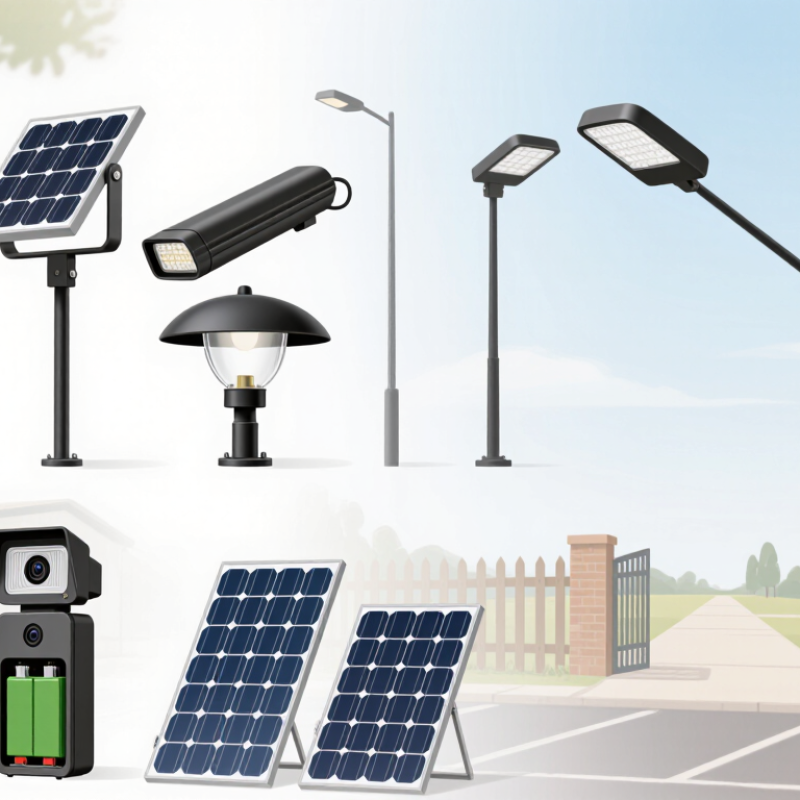
Top 10 Types of Commercial Solar Security Lights?
Flood lights spread powerful illumination across loading bays, parking edges, and storage yards. Their wide beam helps cameras capture movement near gates. However, poor aiming can waste light beyond the property.
Spotlights create a narrower, brighter beam. They suit entrances, signage, and specific equipment zones. Wall-mounted lights work well beside doors and service corridors. They provide useful facial light, but mounting height matters. A low fixture may invite tampering. A high fixture can create harsh shadows.
Area lights cover larger spaces, including walkways and open lots. Street lights use taller poles and broader distribution patterns. Both require careful spacing. The International Energy Agency Photovoltaic Power Systems Programme reported more than 1.6 terawatts of global solar capacity by the end of 2023. This growth supports wider solar-light deployment, though local weather still controls performance. I have seen systems underperform after several cloudy days. That limitation deserves more attention.
Tips: Match the beam to the risk zone. Check winter sun angles before fixing panels. Use motion dimming where steady brightness is unnecessary. The U.S. Department of Energy reports that modern LED systems commonly deliver over 100 lumens per watt, but higher output does not always mean better security. Test glare, shadows, battery recovery, and camera visibility at night. Expect to adjust the layout after real-world observation.
| Type | Typical Commercial Use | Typical Mounting Height | Light Distribution | Typical Coverage | Recommended Solar Configuration | Weather Protection | Main Advantages | Important Considerations |
|---|---|---|---|---|---|---|---|---|
| 1. Solar Flood Lights | Building facades, loading bays, warehouses, storage yards, construction sites, and perimeter zones | Approximately 3–8 m | Wide beam, commonly about 90°–120° | Approximately 150–600 m² per fixture, depending on mounting height, optics, and required illuminance | Remote solar panel, rechargeable lithium battery, dusk-to-dawn control, and motion dimming where appropriate | IP65 or higher is commonly selected for exposed commercial installations | Illuminates large irregular areas and can be aimed toward vulnerable zones | Wide beams can create glare or light spill; photometric planning is needed near roads and neighboring properties |
| 2. Solar Spotlight Security Lights | Gates, entrances, signage, cameras, doors, fences, and specific security targets | Approximately 2.5–6 m | Narrow or medium beam, commonly about 15°–45° | Approximately 50–250 m² per fixture, depending on beam angle and aiming distance | Adjustable panel angle, battery capacity sized for several low-sun days, and optional motion sensor operation | IP65–IP66 is generally suitable for outdoor commercial exposure | Provides focused illumination and can improve visibility at entrances or surveillance points | Small aiming errors can leave dark areas; glare and contrast may affect security-camera images |
| 3. Solar Wall-Mounted Lights | External doors, service corridors, stairways, walkways, utility buildings, and access points | Approximately 2–4 m | Downward, forward, or two-sided wall-wash distribution | Approximately 20–100 m² per fixture | Integrated or separate panel, compact battery, photocell, and motion sensor with standby dimming | IP54–IP65, selected according to exposure and installation location | Simple installation, good access-point visibility, and reduced trenching or electrical work | The wall and surrounding structures can shade the panel; mounting orientation and seasonal sunlight must be checked |
| 4. Solar Area Lights | Parking lots, pedestrian plazas, campuses, commercial grounds, parks, and open storage areas | Approximately 4–10 m | Broad, controlled distribution such as Type II, Type III, Type IV, or Type V roadway-style optics | Approximately 300–1,500 m² per pole-mounted fixture, subject to spacing and lighting requirements | Larger photovoltaic panel, deep-cycle battery, programmable controller, and multi-night autonomy design | IP65 or higher for the luminaire and weather-exposed electrical components | Supports uniform lighting over broad areas and can be designed for pedestrian or vehicle circulation | Requires careful pole spacing, foundation design, battery maintenance access, and glare control |
| 5. Solar Street Lights | Public roads, private access roads, industrial parks, driveways, pedestrian routes, and internal site roads | Approximately 5–12 m | Asymmetric roadway distribution designed to project light along the road | Typically 20–40 m spacing between poles, subject to road width, pole height, optics, and required lighting class | Pole-mounted photovoltaic panel, high-capacity battery, adaptive dimming, and a controller sized for local solar conditions | IP65–IP66 for the luminaire and protected battery enclosure | Provides off-grid road illumination and can reduce dependence on trenching and utility connections | Pole orientation, panel shading, wind loading, battery autonomy, and road-lighting standards must be evaluated before installation |
Note: Coverage, spacing, mounting height, and solar-system sizing are indicative commercial planning ranges. Final selection should be based on a site survey, local sunlight conditions, required illuminance, lighting uniformity, pole structure, and applicable electrical and roadway standards.
Common options include floodlights, spotlights, wall-mounted lights, area lights, and street lights. Motion-sensor, parking-lot, pathway, camera-integrated, and decorative lights are also useful. Each type suits a different risk zone.
Floodlights cover wide areas around loading bays, gates, and storage yards. Their broad beam helps cameras detect movement. Poor aiming can waste light beyond the property.
Spotlights suit entrances, signs, and specific equipment zones. Wall-mounted lights work well beside doors and service corridors. Mounting height matters. Low fixtures may be easier to tamper with. High fixtures can create harsh shadows.
Area lights and parking-lot lights can cover large outdoor spaces. They need careful pole spacing, battery sizing, and lighting layouts. Check winter shade before installation. A larger panel may not solve every problem.
Motion sensors can keep lights dim during quiet periods. They can raise brightness when people or vehicles approach. Set detection zones carefully. One passing truck should not trigger every fixture.
Pathway lights should provide even visibility without harsh glare. Decorative lights can guide visitors through courtyards and office walkways. Appearance should not hide weak illumination. Dark corners remain.
Camera-integrated lights can support visual checks near gates and isolated equipment. They need stable connectivity, weather-resistant housings, and privacy-aware positioning. Test camera visibility at night. Bright light can still create shadows.
Check battery recovery, glare, shadows, activation speed, and camera visibility. Inspect panels monthly for snow, dust, and tree growth. Observe the site across several nights. The original layout may need revision.